

By SHABAN MAKOKHA
July 18, 2026|Every morning, the children of Eshikulusi Primary School wake up to the same routine as millions of learners across Kenya. They put on their uniforms, carry their exercise books, and walk through dusty village paths, greeting neighbours as they hurry to class.
They sing the National Anthem with pride. They recite the alphabet and solve mathematics problems, dreaming of becoming doctors, teachers, engineers, pilots and lawyers.
Yet despite everything that makes them pupils, there is one painful reality they cannot escape: officially, their school does not exist.
For years, Eshikulusi Primary School in Marama Central Ward has remained trapped in bureaucratic limbo — housing learners from ECDE to Grade Four, complete with classrooms, land and teachers, but without formal registration by the Ministry of Education.
To the children, the difference may not yet be fully understood. To their parents and teachers, however, it is a daily source of anxiety. Every passing year raises difficult questions: Will the children transition smoothly into upper primary? Will the government deploy teachers? Will the school receive learning materials? Will it ever be recognized as a public institution?
These questions have lingered over Eshikulusi for years. But for the first time in a long while, hope has begun to replace uncertainty — and it arrived not only in words, but in action.
A Promise Made in Public
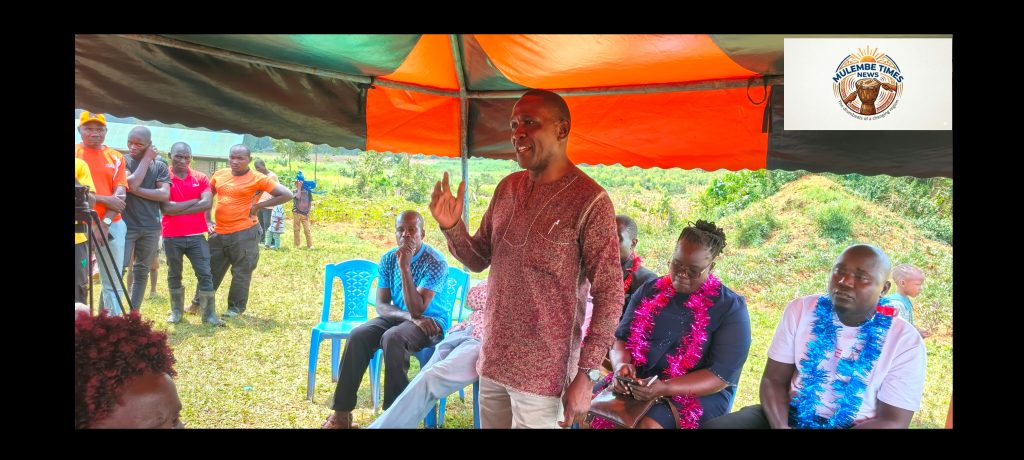
When education advocate and Butere parliamentary hopeful Dr. Lawrence Omuhaka visited the school to commission a modern sanitation block built by a well-wisher, he delivered more than a new facility.
Standing before parents, teachers and eager pupils, he announced that he had personally taken up the school’s registration process after receiving an appeal from respected community elder and longtime friend, Mr. Isaac Ndunde.
“I have followed up on this matter,” Dr. Omuhaka assured the gathering. “I am committed to ensuring that all the necessary processes are completed. By October, I expect this school to have been fully registered so that our children can finally learn in a recognized public institution.”
For many parents, those words carried enormous weight. For years, they have watched their children study in classrooms that seemed invisible to the education system.
Roots of a Long-Standing Struggle
The school itself is not a new dream. Its roots stretch back to the administration of former Kakamega Governor Wycliffe Oparanya, who acquired the land and oversaw the establishment of the learning facilities as an Early Childhood Development Education (ECDE) centre.
As enrolment expanded, so did the community’s aspirations. Parents wanted their children to continue learning in the same environment rather than walking long distances to neighbouring schools. Classrooms were built. Teachers reported to work. Children filled the compound with laughter. But one critical document remained missing — a registration certificate.
According to Dr. Omuhaka, the delay has little to do with infrastructure and everything to do with paperwork. The land on which the school stands is still legally owned by the County Government of Kakamega. Without a transfer of ownership and the necessary title documents, the national government cannot formally register the institution.
Dr. Omuhaka believes that uncertainty must end. He described education as the greatest equalizer society has ever known.
“Education is the only equalizer we know,” he said. “It does not matter whether a child comes from a wealthy family or a humble home.
Every child deserves an opportunity to learn. Parents must ensure that every school-going child is in class.”
He also turned his attention to education funding in Butere Constituency, and without naming names, criticized the incumbent MP for what he described as inadequate investment in school development and bursary support.
He questioned why some learners continue receiving bursaries of only Sh2,000 while neighbouring constituencies allocate as much as Sh7,000 per student.
“It is unfortunate that our children receive only Sh2,000 while elsewhere students receive Sh7,000,” he said. “Our children deserve better. Leadership must always be measured by service delivery.”
The Headteacher’s Quiet Burden
Behind him stood a woman who understands the cost of waiting better than anyone else. Headteacher Josephine Ateya has spent years nurturing a school whose future remains uncertain despite meeting nearly every physical requirement expected of a public institution.
She welcomed the new sanitation block with visible gratitude, describing it as a major improvement to the learning environment. But her greatest prayer extends beyond buildings — school registration.
“We currently have learners up to Grade Four,” she explained. “Next year we shall admit Grades Five and Six. Without registration, our future remains uncertain.”
Her voice carried both hope and urgency: “We humbly ask Dr. Omuhaka to continue supporting us until this process is completed.”
She highlighted challenges familiar to many rural schools — too few teachers, scarce learning materials, growing enrolment and limited resources. Yet despite these obstacles, the school continues opening its gates every morning.
A Community Elder’s Long Wait
Community elder Isaac Ndunde watched the proceedings with quiet satisfaction. For him, this was deeply personal — he was born and raised in Eshikulusi and has watched generations grow up here.
When he learned of the school’s struggles, he knew exactly who to call. “I immediately reached out to our son, Dr. Omuhaka,” he recalled. “Today, the school has a modern latrine, and more importantly, hope has been restored because there is now a commitment to secure its registration.”
Ndunde also challenged parents to protect their children from drug abuse, warning that narcotics continue to rob many young people of promising futures. He urged residents to support leaders who invest in education and community development rather than empty promises.
When Politics Gave Way to Milk and Laughter
Perhaps the most unforgettable moment of the day came after the speeches ended. Politics disappeared, protocols faded, microphones fell silent — then came laughter.
Dr. Omuhaka invited every learner, from the smallest ECDE child to the oldest Grade Four pupil, to enjoy lunch and a packet of milk. For many of the children, it was the happiest part of the day. Tiny hands clutched packets of milk. Bright smiles replaced anxious faces, and the school compound echoed with excitement.
For a few precious hours, registration papers, title deeds and government bureaucracy no longer mattered. The children were simply allowed to be children — laughing, eating together, and dreaming freely.
If the promised registration is completed, October will become far more than another month on the calendar. It will mark the day a school that has existed in the hearts of a community for years is finally recognized by the nation it has always serve.d
And for the hundreds of children who proudly call Eshikulusi home, it will mean something beautifully simple — that their school, and their dreams, have finally been seen.