
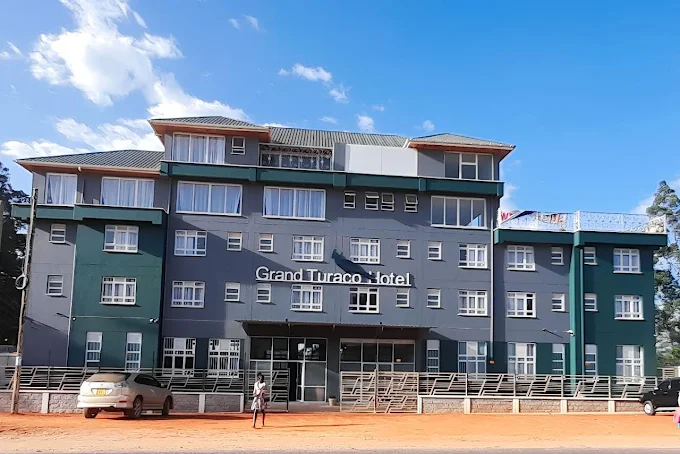
By BOB WASWANI
April 1, 2026| For Moris Mukavale, the letter arrived in September—a piece of paper that would erase his livelihood, his stability, and his dignity in a few cold sentences.
“We’re sorry to inform you that your job with Grand Turaco Hotel will end on 30th September 2025 due to redundancy.”
No warning. No consultation. No chance to say goodbye to colleagues he had worked alongside for years.
Moris was one of seven employees at the Grand Turaco Hotel in Kakamega who received similar letters between September 17 and 18, 2025. The reasons given were always the same: financial constraints, low sales, elimination of positions.
But for Moris and his colleagues—Nicholas Omondi, Pamela Mulama, Lydia Otwero, Kevin Lubutse, Tabitha Pendo, and Milka Sieni—the reasons mattered less than the reality. They had families to feed. Rent to pay. Children in school.
Now, they had nothing.
A Lifeline That Came Too Late
The Kenya Union of Domestic, Hotels, Educational Institutions and Hospital Workers (KUDHEIHA) stepped in quickly. Thomas Mboya, the union’s Kakamega branch secretary, filed an urgent application before the Employment and Labour Relations Court on September 30, 2025, seeking to stop the redundancy.
In his affidavit, Mboya painted a grim picture: employees who had served the hotel for periods ranging from six months to five years, all verbally appointed, all now facing imminent termination. They had not been paid their leave days. They had not received severance pay. The mandatory 30-day redundancy notice had not been honoured.
“The affected employees face imminent termination, loss of livelihood, and irreparable harm,” Mboya argued. “Unless the court intervenes urgently, the suit shall be rendered nugatory.”
But the court was already too late.
The Hotel’s Defense: “We Paid Them”
In response, Grand Turaco’s acting manager, Esther Mumbe Muli, filed a replying affidavit insisting that the hotel had done everything by the book.
She claimed the affected employees had been consulted, issued with one month’s notice, and paid their full terminal dues—including one month’s salary in lieu of notice, severance pay, accrued leave, and gazetted holiday pay. Copies of termination letters, payment breakdowns, and cheques were attached as evidence.
Pamela Mulama, for instance, received a net pay of Ksh66,442. Nicholas Omondi received Ksh56,768. Kevin Lubutse walked away with Ksh89,379. Milka Saeni got Ksh20,040.
The hotel also argued that there was no recognition agreement with the union, that management was unaware the affected employees were union members, and that the redundancy notice had been duly served upon the County Labour Office.
But the union countered that the redundancy had been executed without following the mandatory procedure under Section 40 of the Employment Act. No prior notice to the union. No genuine consultation. No evidence that objective selection criteria—seniority, skill, ability, reliability—had been applied.
“The redundancy was unilaterally implemented and procedurally unfair,” the union’s counsel argued.
A Court Decision That Changed Nothing
When Justice David Nderitu finally delivered his ruling on March 19, 2026, the seven workers had already scattered.
The judge noted that by the time the application was filed on September 30, 2025, five of the grievants had already been paid their terminal dues and their employment terminated. Two others—Lydia Otwero and Tabitha Pendo—had been reinstated, though the circumstances remained unclear.
“The application as at the time of filing had been overtaken by events, rendering the entire application nugatory,” Justice Nderitu ruled.
He dismissed the application with no orders as to costs.
There was no substantive suit on file for the court to determine whether the redundancy had been lawful or not. No basis to award compensation. No order for certificates of service. No justice for Moris, Nicholas, Pamela, Kevin, or Milka.
What Remains
For the workers, the ruling was a quiet end to a loud trauma. The hotel moved on. The union’s application—urgent, impassioned, filed in the nick of time—had arrived just days too late.
Moris Mukavale, who had joined the hotel in May 2025, had no contract to fall back on. No severance package to cushion the fall. He simply disappeared from the court records, a footnote in a case that was dismissed before it could be heard.
The others, paid and processed, faded into Kakamega’s growing ranks of the unemployed.
Justice Nderitu’s parting words offered a sliver of possibility: “If the claimant indeed filed a substantive cause alongside the application, it is free to pursue that cause to its logical conclusion.”
But for the seven workers who lost their jobs at Grand Turaco Hotel, the conclusion had already arrived—delivered in a letter, sealed with a cheque, and buried in a courtroom ruling that came six months too late.
The Human Cost of a Legal Technicality
The case raises uncomfortable questions about Kenya’s labour protections. If a union can file an urgent application to stop a redundancy, but the court takes six months to rule, what happens to the workers in the meantime?
If employers can pay terminal dues and declare the matter settled—regardless of whether proper procedure was followed—what incentive remains for compliance?
And for workers like Moris Mukavale—no contract, no union recognition, no voice—where does the law leave them?
The Employment Act, 2007, is clear: redundancy must follow a strict process. Notice to the labour office. Notice to the union. Consultation. Fair selection. Payment of severance. Certificates of service.
But process takes time. And time, as the Grand Turaco workers discovered, is a luxury they could not afford.