
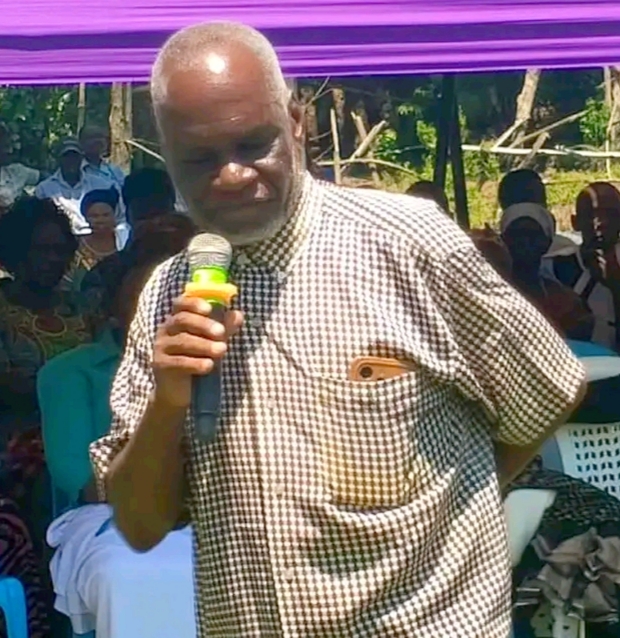
By REUBEN OLITA
September 27, 2026| Veteran football coach Vince Ombiji has described the late Apollo Otidi Oteba as both a friend and an “enemy of football”—a fierce adversary on the pitch and a principled opponent of the sport’s darker practices.
Ombiji, a former Under-20 national team coach, national Special Olympics coach, and coaching instructor, said Oteba never compromised his values, even when confronted with practices he believed were detrimental to the game’s development.
Speaking at Oteba’s burial in Angololo, Kocholya Sub-location, Malaba South Ward, on Saturday, Ombiji recalled first meeting the veteran in 1975 when both were active in playing and coaching.
“We could juggle, head and tackle the ball. We were football coaches and mentors,” Ombiji said.
Their rivalry, he explained, was confined to the field and followed by friendship and shared efforts to promote football.
“You know there are some enemies which only last 90 minutes. After 90 minutes, you are hugging each other and then enjoying yourselves promoting football,” he said.
Ombiji recounted how he and Oteba once spent about three hours drafting proposals on how to improve football in Busia.
“We were in concurrence that what was hampering football development was lack of support from football authorities. We were doing very poorly,” he said.
Ombiji, who hails from Nambale, criticised some Football Kenya Federation officials for skipping Oteba’s burial, citing a mini-league in Nambale as their reason.
He said Oteba’s greatest strength was his refusal to embrace practices common in football during his playing days.
“Apollo was a man of few things. Many people say Apollo was good. Let me tell you the bad part of Apollo,” Ombiji said.
He recalled Oteba’s time at Kenya Prisons when Kenyan football was allegedly affected by beliefs in witchcraft.
“Oteba never subscribed to that ideology. He refused. ‘Hiyo mambo yenu ya uganga kwa mpira, mini time yangu hakuna,'” Ombiji recalled.
He also praised Oteba for refusing to participate in alleged bribery and favouritism during national team selections.
“Some of us were very active, and there was a lot of bribery for you to get into the team. Apollo said, ‘If there is a bribe, let my team remain behind,’ and he did,” Ombiji said.
He linked Oteba’s football philosophy to a period when Kenyan football began undergoing significant development, particularly with the arrival of German coach Reinhardt Fabisch.
“In 1986, we were among the first cohorts for the DFD exam, then under Job Omino as Federation President with Fabisch as instructor. We prevailed upon him to become Harambee Stars coach and it received a mod. The rest is history,” he said.
Ombiji challenged politicians and football stakeholders to invest more in sports, particularly by supporting grassroots talent.
“I am the only coach from kindergarten to the national team. From grassroots to international, or people with mental instability. So tell me a coach who has coached two national teams to club level continentally,” he said.
Former Malaba Central MCA Ishmael Orodi said he was privileged to meet Oteba when he served on the Harambee Stars technical bench.
The football fraternity in Teso North also turned out to honour their staunch member, led by branch treasurer Dan Opuru, who presented an Arsenal T-shirt inscribed “Oteba @ 80” to Oteba’s last-born son, Julius Ochubi.
The burial also witnessed an emotional reunion involving members of the Isamaa Lukorago clan, Oteba’s daughter Ethleen Ilungata Shimoli, her late mother Jane Ajiza’s family, and grandchildren. Following Jane Ajiza’s death, the family was formally handed over to clan patron Albert Fred Ekirapa by Mary Ayuma Shikanga.
Oteba joined the Kenya Prisons Service in 1970 and rose to senior sergeant, pursuing his football passion with Kenya Prisons FC. His performances earned him a place on the Harambee Stars technical bench under Fabisch.
In 1983, he left the Prisons Service after securing employment with Pan Paper as a welfare officer and team coach, serving until his retirement in 1993.
Oteba, who had been diagnosed with prostate cancer, leaves behind two widows, nine children, 17 grandchildren, and one great-grandchild.
Among those who attended the burial were Malaba South MCA Bonface Ekada Mamai and Teso North Council of Elders chairman Wycliffe Oprong.