
By SHABAN MAKOKHA
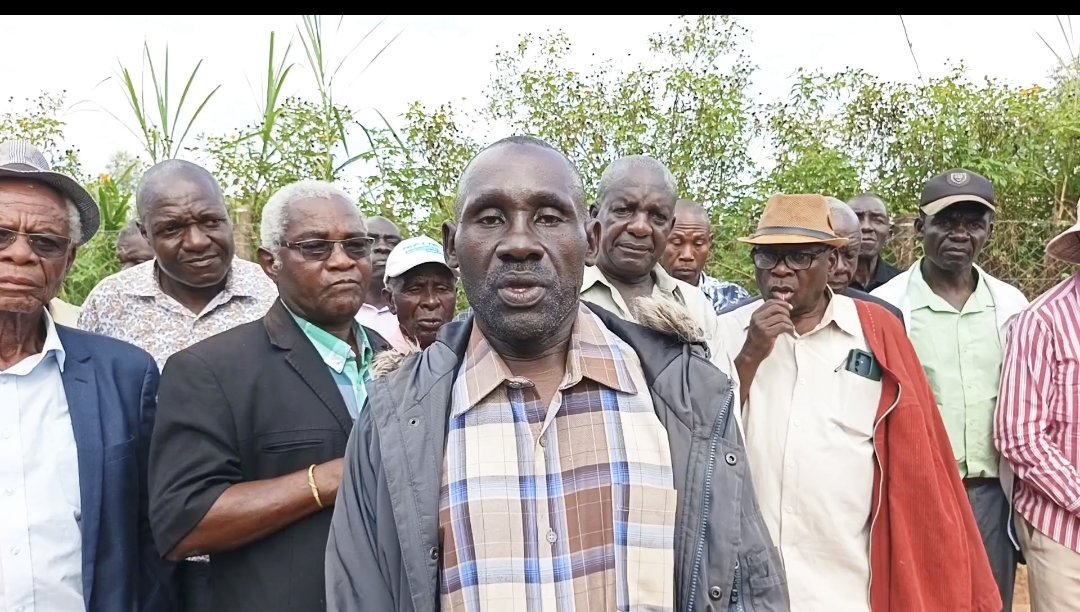
October 4, 2026| Elders drawn from all twelve sub-counties of Kakamega have united to challenge social-media claims targeting Governor Fernandes Barasa, warning residents against turning unverified videos into political weapons.
Their intervention has injected a new dimension into a political storm that has been raging online and now threatens to spill far beyond the rallies and meetings where it began.
The elders say a series of videos circulating online—linked to the Governor’s political activities ahead of the 2022 General Election—have been taken out of context and deliberately presented in a manner that suggests something the footage itself does not establish.
Led by Samuel Asumwa and Elijah Chitayi, the group said the videos do not prove that Barasa sought the services of a traditional medicine practitioner to gain political advantage, as alleged in the increasingly bitter exchanges between the Governor and former Kakamega Senator Cleophas Malala.
For the elders, the controversy is not simply about Governor Barasa. It is about the kind of politics Kakamega wants to practise—and the danger of allowing unverified material to define public figures, destroy reputations and deepen political divisions.
“We must be careful about what we consume and what we share,” said Chitayi, urging residents to establish the truth before forwarding or publishing material whose origin and context they have not independently verified.
The elders maintained that the videos had been misrepresented and did not constitute evidence that the Governor had consulted a traditional healer for political purposes.
A Rivalry Played Out Online
The controversy comes against the backdrop of an increasingly heated political relationship between Barasa and Malala, two influential figures whose rivalry has continued to attract attention across Kakamega and beyond.
What may have begun as political differences has increasingly acquired the character of a battle over reputation, influence and public perception. Social media has become one of the most powerful weapons in that contest.
A video lasting less than a minute can now generate thousands of views before the people featured in it have an opportunity to explain themselves. A photograph can be stripped of its original context and given a completely different meaning. A claim repeated often enough can begin to sound like established fact.
That, the elders argue, is precisely the danger facing Kakamega.
They want residents to resist the temptation to judge political leaders based solely on material circulating on social-media platforms. According to the elders, the Governor should not be condemned on the basis of interpretations imposed on video clips without establishing when, where and why the events captured actually occurred.
A Countywide Intervention
The elders’ intervention is significant because they were drawn from across Kakamega’s twelve sub-counties, giving their statement a countywide character.
Rather than allowing the controversy to remain a contest between rival political camps, they sought to frame it as a question of responsible leadership, truth and the preservation of the county’s social fabric.
Asumwa and Chitayi said political competition should not become an excuse for spreading claims capable of poisoning relations among residents. They urged political leaders and their supporters to compete on the basis of ideas, development records and competing visions for Kakamega rather than personal attacks and allegations whose authenticity has not been established.
Their message comes at a politically sensitive moment, with attention already turning towards the next electoral contest and politicians positioning themselves for future battles. In such an environment, the elders warned, old photographs, videos and statements can easily be resurrected, repackaged and weaponised against political opponents.
For many residents, the controversy offers a sobering reminder of how quickly social media has changed political communication.
In the past, an accusation might take days to reach the wider public. Today, a WhatsApp status, TikTok clip, Facebook post or X message can transform a local political argument into a countywide controversy almost instantly.
This speed can be dangerous. A video can show an event without explaining it. A photograph can capture a moment without revealing what happened before or after. A caption can impose an interpretation that viewers may accept without questioning.
The elders are therefore calling for a return to an old principle: verify before you believe, and verify again before you share. They say political disagreements should never remove the obligation to establish facts.
A Defence, Not a Silencing
Their defence of Barasa, however, is likely to add another layer to the continuing political contest involving the Governor and Malala. For supporters on either side, the controversy is not merely about a video. It is part of a wider struggle over who controls the political narrative in Kakamega.
The elders insist that their intervention should not be interpreted as an attempt to silence criticism of the Governor.
“All we are asking is for the politicians to criticise each other in a sober manner with facts,” said Asumwa.
A governor, they said, remains accountable to the people and should be subjected to scrutiny over his leadership, decisions and public record. But accountability, they argued, should not be confused with the circulation of unverified allegations.
With political temperatures expected to rise as the country moves towards another electoral cycle, the elders want residents to recognise the difference between political criticism and character assassination, between evidence and insinuation, and between legitimate scrutiny and viral misinformation.
“The immediate task is to lower the political temperature,” Chitayi pointed out. “Residents of Kakamega should not allow themselves to be turned into instruments for spreading material they have not verified.”
They also challenged political leaders to demonstrate restraint, arguing that disagreements should be settled through facts, public debate and competing ideas rather than accusations that can inflame communities.
Beyond the Governor
Their defence of Barasa has now placed the elders squarely in the middle of a political storm that is unlikely to disappear soon. But their message goes beyond the Governor.
It is a warning to every Kakamega resident holding a smartphone: before pressing share, ask whether the information is true, whether it has been placed in its proper context, and whether spreading it will contribute to an informed public debate—or simply deepen political hatred.
For Kakamega’s elders, the county must guard its politics against the dangerous marriage of rivalry, misinformation and social media.
Their intervention may have begun as a defence of Governor Barasa. But their larger plea is for something bigger: a political culture in which truth matters more than virality, evidence matters more than rumours, and disagreement does not become a licence to destroy.