
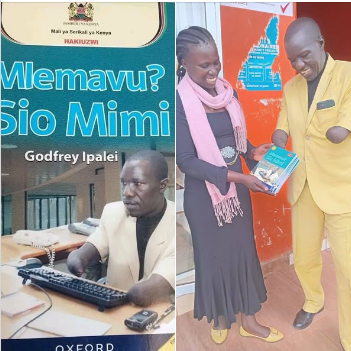
By REUBEN OLITA
April 9, 2026| Godfrey Ipalei’s life nearly ended before it began. Born with stumps in place of limbs, his survival was uncertain until the Igoria clan intervened—saving him from a fate that would have silenced his story forever.
But Ipalei’s story was never meant to end. It was meant to inspire.
From an early age, he defied every expectation. Without hands, he went to school and learned to write using his stumps. Today, his handwriting rivals—and often surpasses—that of many.
After sitting for his “O” Levels in the early 1990s, he narrowly missed university admission, falling short of the required B- with a credit. Yet fate had other plans. A feature in the Sunday Nation caught the nation’s attention, prompting the Ministry of Education to intervene. He was granted admission to the University of Nairobi.
Beyond academics, Ipalei was a force on the football pitch. At Kolanya Boys High School, he dazzled as a left winger—position 11—gliding past defenders before unleashing unstoppable shots that left goalkeepers frozen in disbelief. It earned him the nickname, “Malaria.”
Yet his greatest victories came off the field.
In 2010, he turned his life into literature. “Mlemavu? Sio Mimi” was not written for applause—it was written for survival. A raw, powerful story of struggle, faith, and defiance, it speaks to the inner voice that refuses to surrender.
Years passed. The world moved on. But his story waited.
Until now.
The Kenya Institute of Curriculum Development (KICD) has selected his book as a Grade 10 Fasihi ya Kiswahili set text. What began as a whisper has become a national voice.
This is not only Ipalei’s victory.
It belongs to every student fighting doubt, every person living with disability, and every dreamer told “you cannot.”
His journey proves one thing: strength is not defined by circumstance—it is defined by spirit.
Having known him over the years, I have witnessed his resilience, his growth, and the quiet power of his voice. Today, the nation affirms what many already knew:
Ipalei is a bridge—
from hardship to hope,
from silence to voice,
from despair to possibility.