

By SHABAN MAKOKHA
April 29, 2026| It is not every day that Kenya walks into a room where the future of the planet’s most dangerous knowledge is up for debate. But on a late April morning in New York, at the glass-and-steel headquarters of the United Nations, that is precisely what happened.
The occasion was the 11th Nuclear Non-Proliferation Treaty Review Conference, a high-stakes gathering that runs from April 27 to May 22, 2026. And leading Kenya’s delegation was Justus Wabuyabo, the chief executive of the Nuclear Power and Energy Agency—NuPEA—a man whose calm demeanour belies the weight of the mission in his briefcase.
For the uninitiated, the NPT is the closest thing the world has to a fire extinguisher for atomic anxiety. Signed in 1968 and reviewed every five years, it rests on three pillars: disarmament, non-proliferation, and the peaceful use of nuclear energy. But the 2015 and 2022 review cycles collapsed without consensus, leaving the treaty gasping for relevance. Now, 191 member states have returned to the table, accompanied by the International Atomic Energy Agency, the United Nations, and a sprawling chorus of scientists, civil society groups, and security experts. The task? To examine implementation since 2022—and to rescue a treaty many fear is fraying.
Wabuyabo, speaking before the opening session, chose his words with care. “Kenya fully upholds the principles and obligations of the NPT,” he said. “We are committed to contributing meaningfully to global peace, nuclear security, and responsible scientific advancement.”
But he was not there merely to applaud the old order. He was there to claim a place for Kenya in the new one. For his country, the treaty is not just a shield against catastrophe—it is a key. A key to unlocking nuclear science for cancer treatment in Kisumu, for groundwater mapping in Turkana, for high-yield crops in the Rift Valley. Above all, a key to nuclear energy: reliable, affordable, and sustainable.
And so the conference began, unfolding against a world more jittery than it has been in decades. Geopolitical fault lines are cracking. Regional conflicts burn without resolution. And the old arms-control agreements between Washington and Moscow look like parchment in a rainstorm. Analysts have called this year’s review one of the most consequential in recent memory—not because the treaty is strong, but because it is fragile.
Eng. Lawrence Gumbe, chairman of the NuPEA board, put the stakes in stark terms. “After unsuccessful review cycles in 2005, 2015, and 2022, this year’s conference carries an immense responsibility to rebuild trust in the NPT and safeguard the global non-proliferation regime,” he said. “Delegates must chart a renewed framework for nuclear engagement between the U.S. and Russia.”
Wabuyabo nodded to that urgency in his own voice. “The world is witnessing escalating security uncertainties,” he said. “It is more important than ever for nations to recommit to the NPT as the foundation of global nuclear order.”
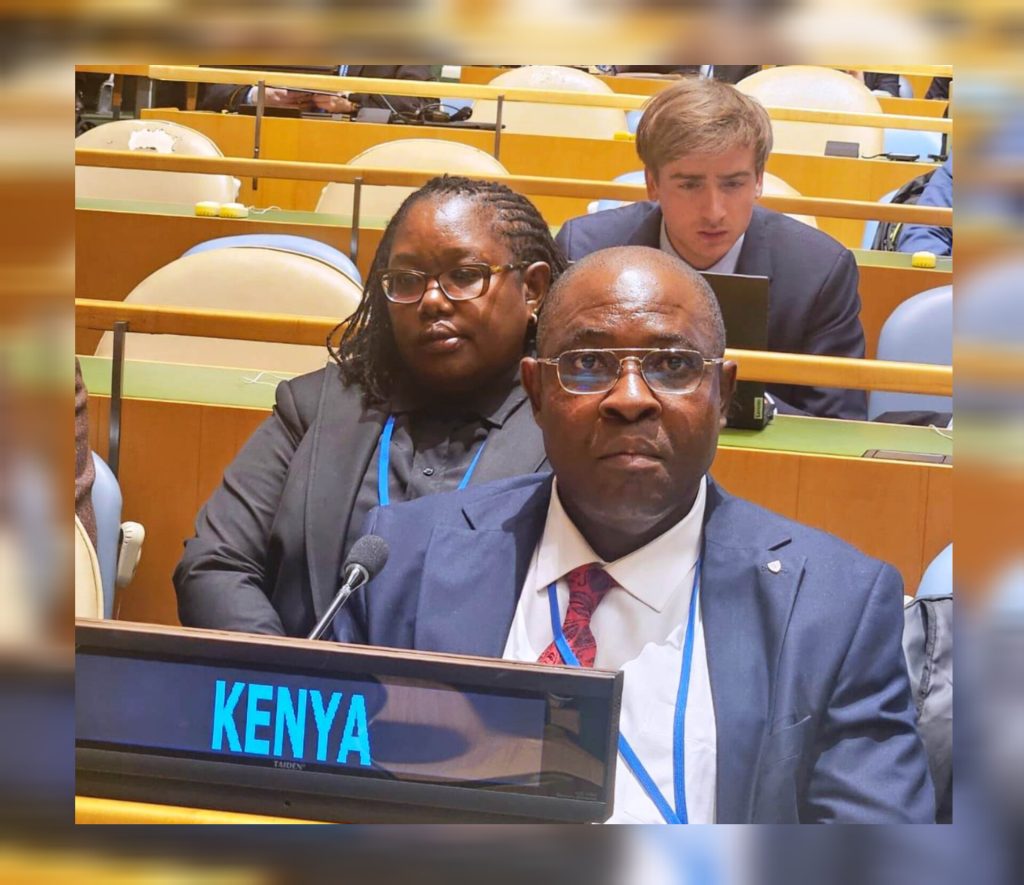
Over the four weeks that follow, Kenya’s delegation will move through a dense thicket of bilateral and multilateral meetings. They will talk safety, security, and technology transfer. They will discuss medical isotopes and agricultural innovation. They will negotiate training for Kenya’s nascent nuclear workforce and cooperation with the IAEA on a power programme still taking shape. And they will lend Africa’s collective voice—earnest, insistent, undimmed—to the twin causes of disarmament and peaceful science.
For Kenya is no newcomer to this fight. A committed member of the African Commission on Nuclear Energy (AFCONE) and a signatory to the Treaty of Pelindaba, it has long championed a nuclear-weapon-free continent. But it has also championed access—fair, unfettered access—to the fruits of the atom for those who seek only to heal, feed, and power their people.
“Nuclear science is not just about energy,” Wabuyabo said, as the New York light fell through the UN windows. “It is about development, health, food security, water security, innovation, and national resilience.”
By the time the conference ends, the delegates will try to do what has eluded them for three cycles: adopt a consensus final document. It will not be easy. Geopolitics is a jealous god. But expectations remain that Kenya’s active, assertive presence will yield what it came for—partnerships, collaborations, and commitments that outlast any single treaty.
And as the world gathers to reaffirm an agreement that has held—just barely—for more than five decades, one thing becomes clear. Kenya is no longer just a spectator to history. It is reaching for the pen.